
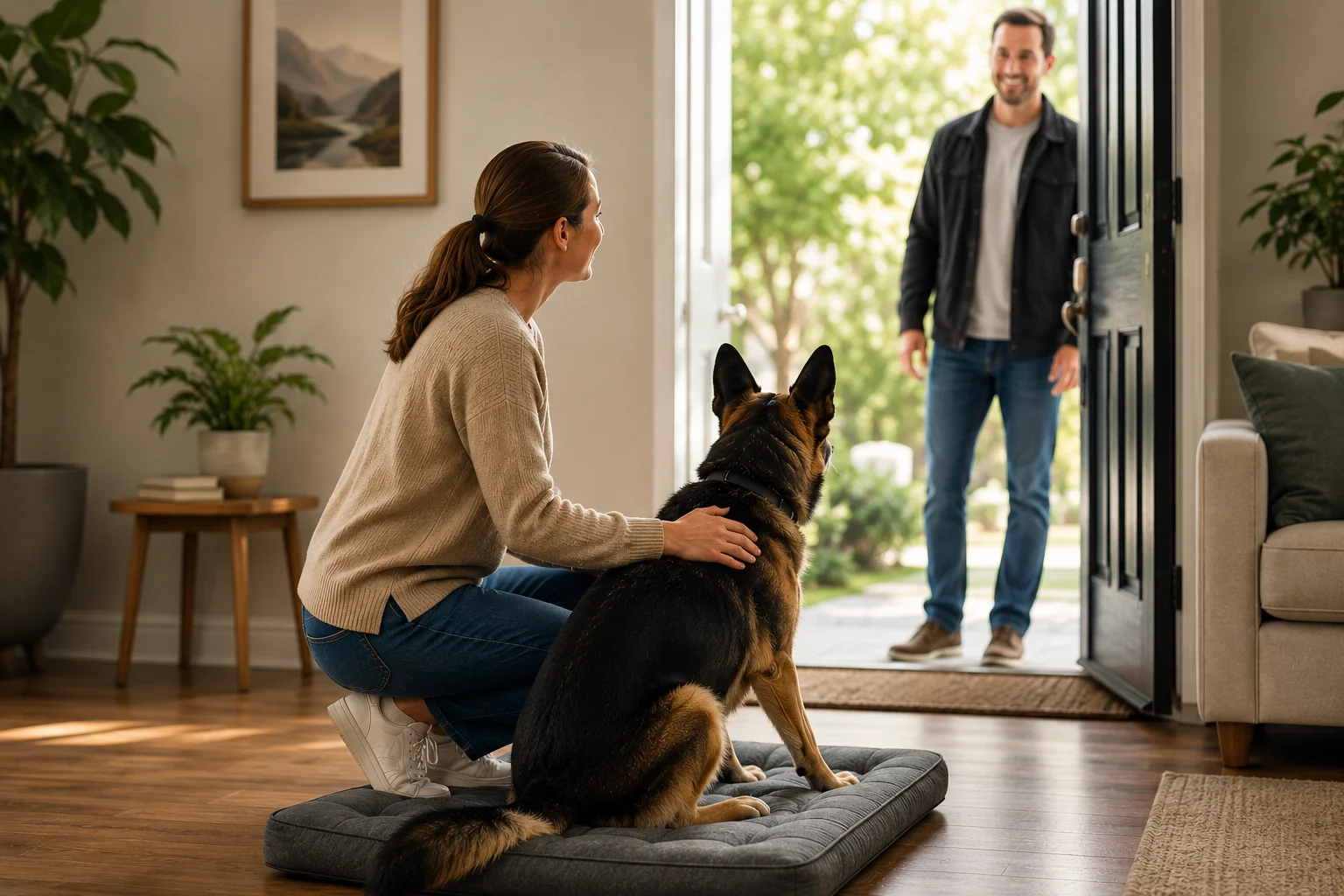
You’ve been dreading the knock at the door for months. A friend stops by, and before they’re even inside, your dog is at the door barking like their life depends on it. Someone reaches out to say hello and your dog lunges. A family member sits down and your dog won’t stop circling, growling, hackles up, eyes locked.
You love your dog. You know they’re not bad dogs. But you also know something has to change before someone gets hurt or before you stop inviting people over entirely.
This is one of the most common problems we see at Topanga Pet Resort, and it’s also one of the most misunderstood. Aggression toward guests isn’t random. It’s not about your dog being dangerous or untrainable. It’s a communication problem, and once you understand what your dog is actually trying to say, the path forward becomes a lot clearer.
This guide covers the real causes of guest aggression, what makes it worse, how professional trainers approach it, and what you can do at home between sessions. If your dog is aggressive with guests, this is the place to start.
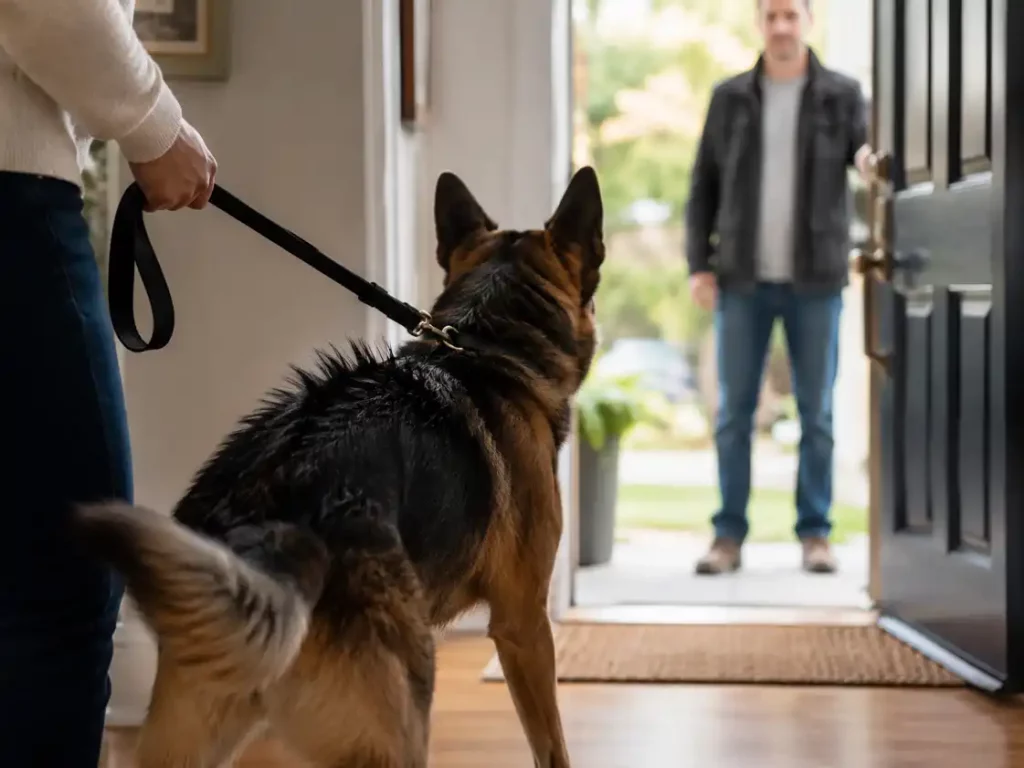
What’s Actually Happening When Your Dog Lunges at Visitors
The first thing most owners assume is that their dog is aggressive. The more accurate word is usually reactive, and the emotion driving it is almost always fear or anxiety, not dominance or malice.
What we perceive as aggression often starts as anxiety. The barking, the raised hackles, the charging toward a stranger, these aren’t signs of a bad dog but rather a complex interplay of instinct, fear, and learned behavior.
Your dog lives in your home and considers it their territory. When a stranger enters that space, the dog’s nervous system responds. If they don’t have enough positive experience with strangers, or if they’ve learned that barking and lunging makes the person back off or retreat, they’ll keep doing it because it works.
Dogs may exhibit territorial aggression toward strangers to protect their loved ones, and a fearful dog can display aggressive behavior as a defense mechanism, especially when they’ve experienced trauma or lack of socialization.
That “aggression” you’re seeing is often your dog saying: I don’t know this person, I don’t feel safe, and I need them to go away. The problem is they’ve found an effective way to communicate that, and now it’s a deeply reinforced habit.
The Different Types of Guest Aggression and Why They Matter
Not all guest aggression looks the same, and the type your dog is showing matters a lot for how you address it. Treating fear-based aggression the same way you’d treat territorial aggression will stall your progress and sometimes make things worse.
Fear-Based Aggression
This is the most common type. The dog isn’t protecting territory so much as protecting themselves. Signs include:
- Barking while backing away or trying to leave the room
- Growling when a guest moves toward them, even slowly
- Snapping when cornered or when a guest reaches over their head
- Body language that looks tense but also ready to flee
These dogs are not trying to dominate anyone. They’re scared and they’ve learned that showing teeth or lunging creates distance between them and the thing that frightens them.
Territorial Aggression
This version is more about the space than the person. The dog may be fine with a guest once they’ve settled inside, but goes into full alarm mode when someone approaches the door or enters through it. The threshold, literally the doorway, is the trigger.
Signs include:
- Intense reaction at the door that calms significantly once the visitor is inside and seated
- Patrol behavior, walking the perimeter of a room or yard when strangers are present
- Escalation when guests move toward areas the dog considers “theirs”
Resource Guarding Extended to People
Some dogs that have a strong bond with a specific person will guard that person from guests. They perceive the guest as a threat to their access to their favorite human, and they react accordingly.
If dogs feel something they care about is under threat, whether food, territory, or a loved one, they may act out aggressively in defense.
Understanding which category your dog falls into changes everything about how you train. At Topanga Pet Resort, our certified trainers spend real time identifying the root cause before any behavior modification begins, because the wrong approach doesn’t just fail, it can set things back.
Why Punishment Makes This Worse
This is the part most owners don’t hear until they’ve already tried it.
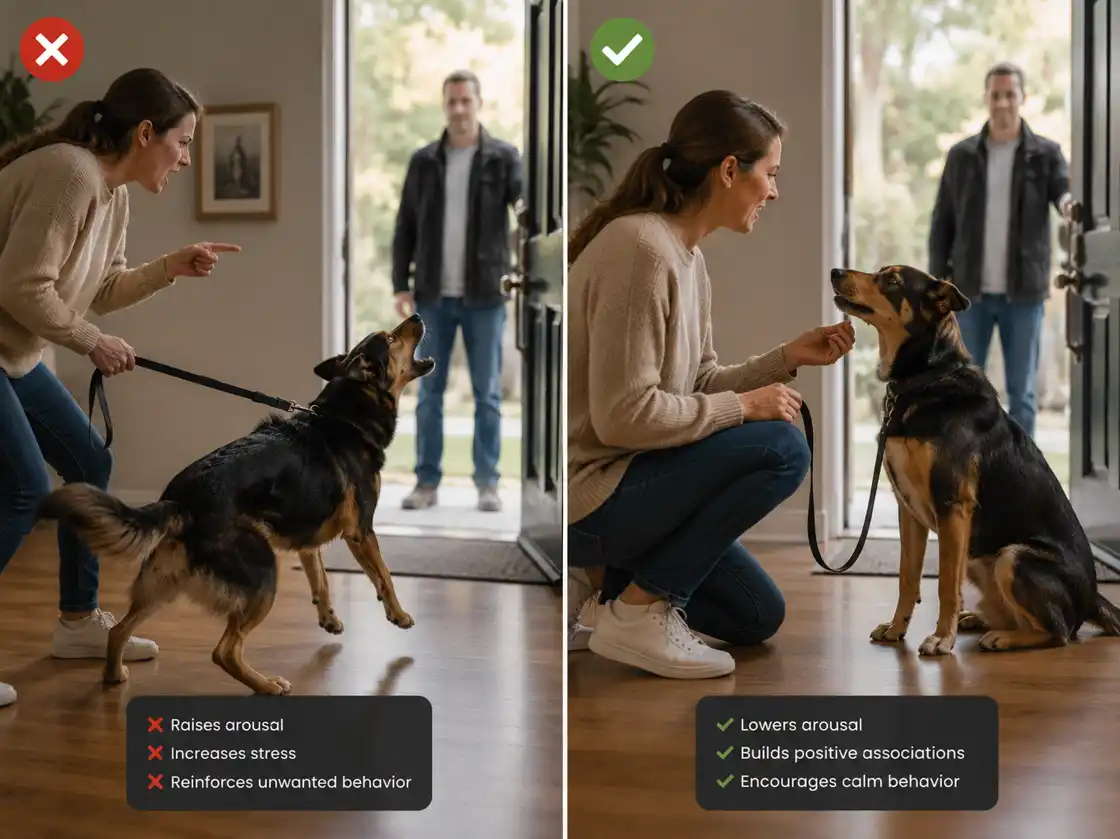
When a dog lunges at a guest and you correct them harshly, jerk the leash, shout, or use an aversive tool without proper guidance, you’re not addressing the emotion behind the behavior. You’re just adding more stress to an already stressed dog.
The result is often a dog that learns to suppress the warning signs, the growling, the stiff body, the hard stare, and goes straight to biting. That’s genuinely more dangerous than a dog that growls. Growling is communication. A dog that skips that step because they’ve been corrected out of it is unpredictable.
Good management and handling of an aggressive dog will help to prevent bite injuries. The aim is to avoid or at least limit things that trigger aggression and to handle the dog in a way that keeps everyone safe.
That doesn’t mean you let the behavior continue unchallenged. It means the challenge has to be structured, positive, and strategic. Which brings us to what actually works.
What Actually Works: How Trainers Approach Guest Aggression
Step 1: Management First, Training Second
Before any training begins, you need to manage the environment so the dog can’t rehearse the behavior. Every time your dog lunges at a guest and the guest backs off or freezes, the behavior gets stronger. Repetition reinforces it.
Practical management strategies that work:
- Crate or leash your dog before guests arrive, not as punishment but as structure
- Use a baby gate to give the dog a safe space with a view of guests without direct access
- Have a “go to your place” command trained before guests come over, so you have a tool to use
- Ask guests not to approach or make eye contact with the dog on entry
For dogs who show aggression towards visitors to the home, it’s important to physically separate the dog from visitors at all times when first starting training.
Management isn’t the solution. It’s the container that makes the solution possible.
Step 2: Desensitization, Gradual Exposure Done Right
Desensitization means slowly, systematically, exposing your dog to the thing that triggers them at an intensity low enough that they don’t react. The goal is to change the emotional response, not just suppress the behavior.
For guest aggression, this looks like:
- Starting with a guest simply standing outside the door while your dog stays calm inside
- Rewarding calm behavior consistently with high-value treats
- Gradually decreasing the distance between the dog and the guest over multiple sessions
- Never pushing past the point where the dog begins to show stress signals
The pace matters enormously. Going too fast doesn’t save time, it resets progress. What we typically find at Topanga Pet Resort is that owners underestimate how sensitive their dog’s threshold is and push introductions too quickly, which is one of the most common reasons home training stalls.
Step 3: Counterconditioning, Changing the Association
Counterconditioning pairs the trigger (a guest arriving) with something the dog loves (a high-value treat, a toy, a game) until the dog begins to associate the guest with something good.
Over time, the dog starts to feel something different when they see a stranger at the door. Instead of alarm, they start to anticipate something positive. That shift in emotional response is what makes the behavior change sustainable.
Counterconditioning means replacing negative reactions with positive associations by offering treats and praise, and behavior modification involves introducing triggers gradually in a safe, controlled manner.
This is not the same as just giving your dog a treat when they’re already in a heightened state. Timing and threshold management are everything. A dog that’s already lunging and barking is past the point where a treat registers. The treat has to come before the reaction, not after.
Step 4: Building a Reliable “Settle” or “Place” Command
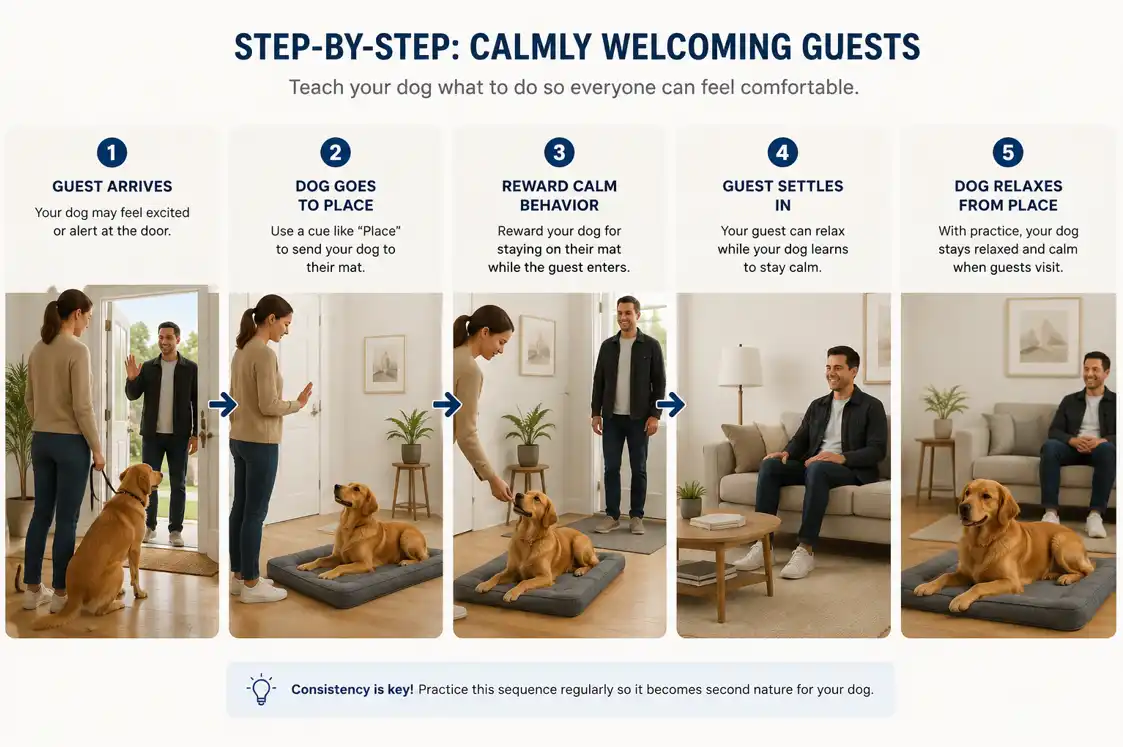
One of the most practical tools for managing guest aggression long-term is a strong place or settle command. This gives your dog somewhere to go and something to do when guests arrive, which takes them out of the “guard the door” mode and puts them into a structured, rewarded state.
When this command is trained well:
- The dog goes to a specific spot (a mat, bed, or crate)
- They stay there while guests enter and settle in
- They’re rewarded for staying calm in that position
- Guests can choose to approach the dog at the dog’s pace later in the visit
This is not about shutting the dog down. It’s about giving them a clear job that channels their energy constructively and prevents rehearsal of the unwanted behavior.
Common Mistakes That Keep the Problem Going
You’ve probably tried a few things already. Here are the patterns we see most often that slow progress down or make things worse:
Flooding the dog with guests
Some owners think more exposure will fix the problem. Bringing a dog that bites guests into a party is not desensitization. It’s flooding, and it tends to make the dog more reactive, not less. Controlled, low-intensity exposure is what works.
Letting guests ignore the rules
You set the rules. Your guests don’t follow them. Someone reaches out to pet the dog despite being told not to. The dog snaps. Now you’re back at square one. Consistent management of the environment means managing the people in the room too.
Expecting one session to fix it
Guest aggression is a deeply ingrained behavior pattern often months or years in the making. Improvement takes time, consistency, and the right approach. Owners who stick with the process see real change. Owners who try it once and give up conclude the dog is unfixable, and that’s rarely true.
Reassuring the dog when they’re reactive
“It’s okay, it’s okay” in a soothing voice while your dog is growling tells the dog their emotional state is appropriate for the situation. You’re not calming them down, you’re confirming their assessment of the threat. Stay calm yourself, but redirect rather than reassure.
When It’s Time to Work With a Professional Trainer
Some dogs make meaningful progress with consistent owner-led training. Others need professional help, and there’s no shame in that. Guest aggression that involves biting, a history of escalation, or a dog that’s already injured someone is not a DIY project.
Signs it’s time to call in a certified trainer:
- Your dog has bitten someone, even once
- The behavior has escalated over time rather than stabilized
- You’ve tried consistent training at home and aren’t seeing progress
- You’re anxious every time someone comes over and that anxiety is affecting your dog’s state
- Your dog lunges at strangers in the home regardless of the guest’s behavior
61 percent of dogs presented to behaviorists show human-directed aggression, and dogs attending professional training classes show decreased risk for aggression toward unfamiliar humans and better socialization outcomes.
A certified trainer can assess your specific dog, identify what’s driving the behavior, and build a plan that accounts for your dog’s history, temperament, and triggers. Generic advice only goes so far. Your dog’s situation is specific, and the solution should be too.
What Professional Training Looks Like at Topanga Pet Resort
At Topanga Pet Resort, we’ve spent over 50 combined years working with dogs of every temperament, background, and behavior challenge. Our team of 6 certified trainers has seen guest aggression in every form, from mild reactivity at the door to cases that had owners genuinely afraid in their own homes.
What makes our approach different from a generic obedience class or a YouTube tutorial is that we work with the whole dog. The environment here matters. Dogs work and board in a large indoor and outdoor facility with country views, open space, and 5 to 6 hours of supervised play daily. That physical and mental outlet is part of the behavior equation. A dog that’s exercised, stimulated, and socially regulated is a dog that’s far easier to train.
Our trainers don’t use a one-size formula. We spend time understanding your dog’s specific triggers, history, and threshold before building a training plan. And because dogs spend time here in a structured social environment, we’re able to work through introductions with new people in a controlled, repetition-rich setting that would be hard to replicate at home.
We also use premium nutrition as part of how we support dogs in our care. A dog whose physical needs are consistently met is more emotionally regulated and more receptive to training.
If you’re dealing with guest aggression and want real answers from people who work with this every single day, we’re here.

How to Set Up Guest Visits During Training
While you’re working on this, guests are still going to come over. Here’s a practical protocol that gives you structure without requiring perfection:
Before the guest arrives
- Exercise your dog. A tired dog has a lower stress baseline.
- Set up the place mat or crate in the room where guests will sit.
- Have high-value treats ready, something the dog doesn’t get any other time.
- Brief your guest on what to expect and what not to do.
When the guest arrives
- Put your dog on leash or in their place before anyone knocks.
- Ask the guest to come in without making eye contact with or reaching toward the dog.
- Reward your dog for calm behavior immediately and consistently.
- Keep the energy in the room low. Excited greetings at the door escalate the dog’s state.
During the visit
- Let the dog observe from their place. Don’t force an introduction.
- If the dog stays calm, allow them to approach the guest on their own terms.
- Instruct the guest to let the dog sniff, avoid direct eye contact initially, and offer a treat if the dog approaches without tension.
- If the dog escalates, calmly remove them from the room without drama.
What to avoid
- Letting the guest reach over the dog’s head
- Forcing the dog to interact if they’re not comfortable
- Correcting the dog harshly during the visit
- Allowing children to approach the dog unsupervised
This won’t fix the problem on its own. But it stops the problem from getting worse while you’re working on it.
Get Real Help for Your Dog’s Guest Aggression
If your dog is aggressive with guests, don’t wait until someone gets hurt or until the behavior becomes so ingrained that recovery takes years instead of months.
Email: topangapet@gmail.com
Visit us: topangapetresort.com
Located at 1776 Old Topanga Canyon Rd, Topanga, CA 90290. Trusted by dog owners across LA with 130+ Google reviews and 30+ Yelp reviews.
Frequently Asked Questions About Dogs Aggressive With Guests
Why is my dog aggressive with guests but fine with family members?
Your dog knows your family members. They’ve built positive associations with them through daily exposure, shared space, and routine interaction. Guests are strangers entering territory your dog considers theirs, and without enough positive experience with new people, the dog’s default response is alarm or fear. It’s not personal toward the guest. It’s a socialization gap combined with a learned behavior that the dog has found effective.
Can a dog that has bitten someone be retrained?
In many cases, yes. A single bite incident doesn’t mean a dog is permanently dangerous or untrainable. What matters is understanding why the bite happened, what the warning signs were, whether the dog gave signals that were missed or ignored, and building a structured plan to address the underlying cause. That said, bite history cases should always be handled by a certified professional, not addressed through general advice or YouTube tutorials.
How long does it take to stop guest aggression?
It depends on how long the behavior has been going on, how severe it is, how consistent the training is, and the individual dog’s temperament. Mild cases with structured daily training can show meaningful improvement in 4 to 8 weeks. More established patterns with bite history may take several months of consistent professional work. There’s no honest timeline that applies to every dog, and anyone who promises you a quick fix isn’t giving you accurate information.
Should I use a muzzle when guests come over?
A properly fitted basket muzzle is a legitimate safety tool for dogs with bite history during the early stages of training. It is not a punishment and does not hurt the dog. Muzzle conditioning, teaching the dog to wear it comfortably and associate it with positive things, should be done before you need it in a stressful situation. A muzzle manages safety. It doesn’t replace training.
My dog only does this at home, not outside. Why?
Because the home is your dog’s territory. Outside, your dog is in neutral space and doesn’t feel the same ownership over it. The threshold behavior you see at the door and in the home is specifically triggered by the combination of territory and stranger. This is actually useful information because it helps identify the trigger precisely, which makes training more targeted.
What’s the difference between a reactive dog and an aggressive dog?
Reactivity is typically a big, intense response to a trigger that includes barking, lunging, and arousal but doesn’t necessarily involve intent to harm. Aggression involves genuine intent to threaten or cause harm, often signaled by a hard stare, stiff body, low growl, and escalation toward contact. Many dogs that owners call aggressive are actually reactive, which is a meaningful distinction because reactivity is generally more responsive to training. A certified trainer can help you understand which you’re dealing with.
Is this my fault as an owner?
Almost never in the way people assume. Guest aggression typically comes from a combination of genetics, early socialization gaps (the critical window is before 16 weeks), and learned behavior that has been unintentionally reinforced. Preventing human-directed aggression is most effective when addressed while a dog is young, with puppies ideally meeting at least 100 different people before they reach 16 weeks of age. If your dog is past that window and showing guest aggression, it’s not about fault. It’s about finding the right path forward.
When should I consider boarding and training?
Board and train programs make sense when you need consistent, high-repetition training in a structured environment that’s hard to replicate at home. If your dog is spending time with trainers daily, being introduced to new people regularly in a controlled setting, and building positive associations in a professional facility, progress often happens faster than it would with weekly sessions. It’s also useful when the home environment itself is part of what’s reinforcing the behavior.





